
A lot of parents come to us with the same worry. They think they have to choose: either their child memorizes Quran, or their child gets a strong education. Pick one, lose the other. It sounds like a fair trade, but it isn’t one you actually have to make.
At American Leadership Academy, we run both tracks side by side, in the same school day, with one team of teachers watching over both. Before we explain how that works, it helps to look at how most families handle Hifz right now, because the differences matter more than people expect.
Four Ways Families Handle Hifz Today
Full-time Hifz-only schools. These schools spend most of the day on memorization. There’s little room for math, science, or English, and usually no accredited diploma at the end. Families choose this path when finishing Hifz quickly matters more than anything else. It can work, but it comes with a real cost later, when a student needs a diploma for college or a job.
Weekend or after-school Hifz. Here, a child goes to a regular school during the week, then adds Hifz classes on weekends or evenings. It’s flexible, and it doesn’t force a family to give up their current school. The tradeoff is speed. Progress is slower, and parents end up managing two separate schedules, two sets of teachers, and two sets of expectations.
Online or self-paced Hifz. This option is convenient and often cheaper. A child can review at home, on a schedule that fits the family. But it depends almost entirely on the parent staying consistent day after day. Life gets busy, and consistency is hard to keep up without a school structure behind it.
Schools that combine both. This is a smaller category, but it’s growing. Hifz and regular academics happen inside the same school day, taught by teachers who talk to each other about a student’s full workload, not just their own subject.
A Simple Comparison
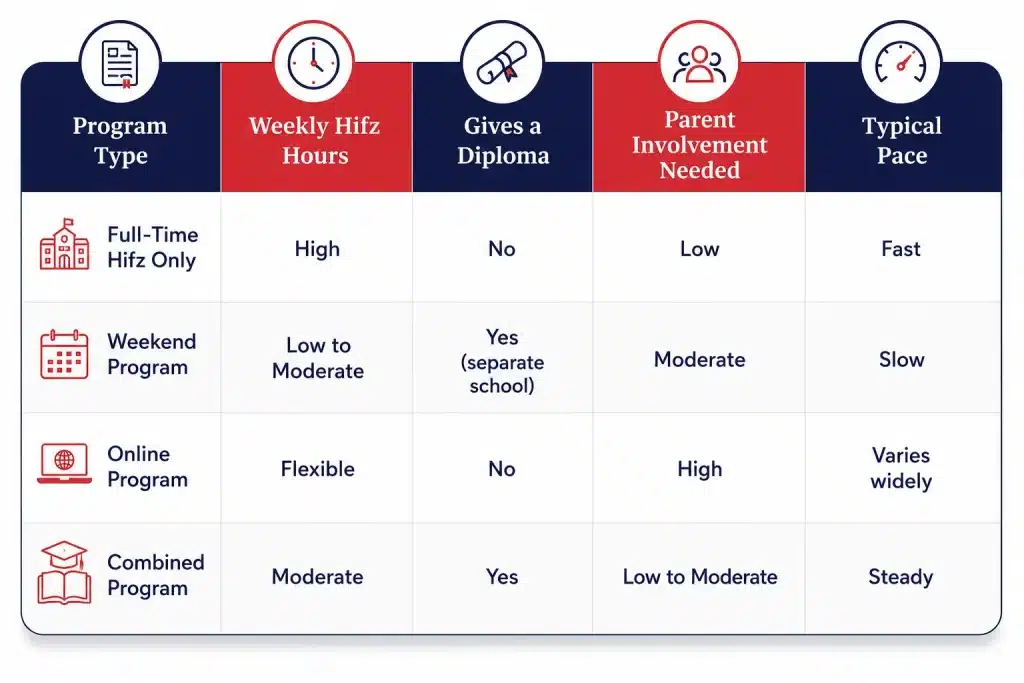
Look at that table and the pattern is clear enough. Full-time Hifz gets you speed, but you give up a diploma. Weekend and online programs keep a diploma option open, but they lean hard on the parent to hold everything together. A combined program lands in the middle. It’s not the fastest way to finish Hifz, but it’s the only option here where a student gets steady progress on the Quran and a recognized education, without the family carrying the whole weight of it.
That middle ground is exactly what our academics program was built around. We didn’t want to force families into picking a lane.
How ALA Runs the School Day
Here’s roughly what a day looks like for a student in our combined program. Mornings start with core subjects like math, English, and science, the same classes any accredited school would run. Quran and Islamic Studies blocks are built into the schedule too, not tacked on at the end of a long day.
The part that actually makes this work isn’t the schedule itself. It’s that our Hifz teachers and our academic teachers talk to each other. If a student has a big exam coming up in science, the Hifz teacher knows about it and won’t schedule a heavy review session the same week. That kind of coordination sounds small, but it’s the thing that breaks down in most weekend or online setups, where the two sides of a child’s education never actually communicate.
We also track Hifz progress student by student, not class by class. Some kids move faster than others, and that’s fine. A student who needs more time on a certain surah isn’t held to the same pace as everyone else, and they’re also not allowed to fall behind in their regular coursework while they catch up. Both tracks move forward, just not always at the exact same speed for every child.
Families who want to see this in person are welcome to visit one of our campuses and sit in on a class before deciding.
Why This Balance Pays Off Later
Two things matter here, and they’re easy to overlook when you’re focused on the day-to-day.
First, a Cognia-accredited diploma keeps doors open. Whether a student finishes Hifz in two years or five, they still walk away with a diploma that colleges and employers recognize. That’s not true for every path we listed above, and it’s worth thinking about before committing to a program that skips accreditation entirely.
Second, daily practice inside a school setting tends to stick better than practice that depends on remembering to do it at home. It’s not that home practice doesn’t work. It’s that a set time, a set teacher, and a set place remove a lot of the friction that causes review to slip in the first place. Kids forget. Parents get busy. A school schedule doesn’t.
Making the Choice
None of the options above are wrong, exactly. A full-time Hifz school might be the right call for a family with a specific timeline in mind. A weekend program might fit better for a family that isn’t ready to change schools. What we’ve found, working with families for years now, is that most parents aren’t actually trying to choose between Hifz and academics at all. They just haven’t seen a version where they don’t have to.
If that sounds like where you are, we’d rather show you than explain it further. You can apply now or reach out to schedule a visit, and see how the schedule, the teachers, and the students actually work together on a normal day.
Tags: american leadership academy, Hifz and academics together