Finding a good Islamic school near you is not always easy. You want your child to get a strong education. You also want them to grow up with their faith at the center of that education, not treated as an afterthought. For a lot of Muslim families in the US, that combination is hard to find.
The good news is that full-time Islamic schools are growing across the country. American Leadership Academy is one of the few that brings Cognia-accredited academics and full-time Islamic education together under one roof, with campuses in cities like Allen, San Antonio, Tulsa, and High Point. But every family’s situation is different, and knowing what to look for before you visit any school can save you a lot of time.
This guide walks you through the four things that matter most when comparing Islamic schools, then breaks it down city by city so you can see what is actually available where you live.
What to Look for in Any Islamic School
Before you start visiting schools, it helps to know what questions to ask. These four things come up again and again for families who have already been through this process.
Accreditation. This one matters more than most families realize. An accredited school has been reviewed by an outside organization and confirmed to meet academic standards. Cognia is one of the most recognized accreditation bodies in the US. When a school has Cognia accreditation, it means the academics are held to a real standard, not just whatever the school decides on its own. This also matters later when your child applies to college or transfers between schools.
Full-time vs. weekend programs. A lot of families start with weekend Islamic classes at their local masjid. That is better than nothing, but it is a different experience from a full-time Islamic school. In a full-time setting, your child learns Quran, Arabic, and Islamic studies every single day alongside their regular classes. Over twelve years, that adds up to something very different.
Cost and financial programs. Private Islamic school is an investment. But several states now have programs that help cover tuition, and a lot of families do not find out about them until after they have already enrolled somewhere else. In Texas, the Texas Education Freedom Account (TEFA) program can cover private school costs for qualifying families. Oklahoma has the Parent Choice Tax Credit. North Carolina has the Opportunity Scholarship. These programs exist and they are worth knowing about before you decide.
School environment. Academics and faith are the big ones, but the day-to-day environment matters too. Class size, how involved other parents are, whether the school feels like a real community, these things shape your child’s experience every single day.
Islamic Schools in Allen, TX
Allen sits in the heart of one of the fastest-growing Muslim communities in the Dallas-Fort Worth area. Families there are actively looking for full-time Islamic schooling, and the demand has grown a lot over the past few years.
When comparing Islamic schools in Allen, start by checking accreditation. Then ask whether the school covers kindergarten through 12th grade. A school that only goes up to 5th or 6th grade means you will have to find a new school for your child in the middle of their education. That is a disruption most families would rather avoid.
The TEFA program is worth bringing up with any school you are considering in Allen. Under this program, Texas families can use state funds to pay for private school tuition. Not every private school is registered to accept TEFA, so ask early.
American Leadership Academy’s Allen campus is a full-time, Cognia-accredited Islamic school that serves K through 12 students. It is one of the few options in the area that accepts TEFA, which makes it more financially accessible for families who qualify. You can learn more about the Allen campus and TEFA on the ALA Texas Allen Islamic School and Education Freedom Accounts page.
Islamic Schools in San Antonio, TX
San Antonio has a smaller Muslim community than DFW, and that means fewer Islamic school options. For families there, the decision often comes down to what is realistically within reach, whether that means a school close to home, a short commute, or a structured program that serves all grade levels.
The same questions apply here. Is the school accredited? Does it go all the way through high school? Does it accept TEFA?
One thing families in San Antonio often find is that the most established Islamic school options require some travel. That is worth planning for rather than discovering after enrollment.
ALA has a campus that serves San Antonio families looking for a structured, accredited Islamic school with a full K through 12 program. Find location details on the ALA locations page.
Islamic Schools in Tulsa, OK
Tulsa has a solid Muslim community, but full-time Islamic school options have been limited for a long time. A lot of families there have relied on weekend programs at the masjid, which work for some families but leave others wanting more for their kids.
If you are in Tulsa and thinking about a full-time Islamic school, the main things to look at are: whether a full-time option actually exists nearby, how the academic program compares to what your child would get in public school, and what grades the school covers.
Oklahoma’s Parent Choice Tax Credit is something every Tulsa family should look into. The program allows qualifying families to use tax credit funds toward private school tuition. It has made full-time Islamic schooling more affordable for Oklahoma families than it was even a couple of years ago.
ALA’s Tulsa campus gives families a full-time option with Cognia accreditation and a K through 12 program.
Islamic Schools in High Point, NC
The Greensboro and High Point area of North Carolina has seen real growth in Muslim families over the past decade. The need for full-time Islamic schooling has grown alongside it.
When looking at Islamic schools in High Point, check whether the school covers all grade levels. Some Islamic schools in smaller cities only offer elementary grades, which means you will need to find a different school once your child gets older. That kind of disruption is worth avoiding if you can.
North Carolina’s Opportunity Scholarship is one of the most valuable and least-talked-about programs for families in this area. It provides funding for qualifying families to cover private school tuition. A lot of parents do not find out about it until they are already committed to a school.
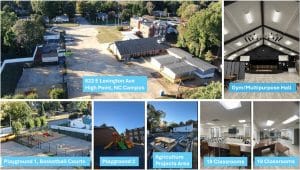
ALA’s High Point campus is Cognia-accredited and serves students from K through 12, which means your child can stay in the same school community all the way through graduation.
How These Cities Compare at a Glance
Here is a quick look at what is available across all four cities.
| What to Check | Allen, TX | San Antonio, TX | Tulsa, OK | High Point, NC |
|---|---|---|---|---|
| Full-time Islamic school | Yes | Yes | Yes | Yes |
| Cognia accredited | Yes | Yes | Yes | Yes |
| K through 12 program | Yes | Yes | Yes | Yes |
| State financial program | TEFA | TEFA | OK Parent Choice | NC Opportunity Scholarship |
Questions to Ask Before You Enroll
Before you commit to any school, go through this list. These are the questions that matter most and the ones that are easiest to forget to ask in the middle of a school visit.
- Is the school accredited, and by whom?
- Does it cover K through 12, or only certain grades?
- What does Islamic studies look like on a regular school day?
- Does the school accept any state scholarship or funding programs?
- Can you visit the campus and sit in on a class before deciding?
- How does the school support kids who are coming from public school?
The Bottom Line
The right Islamic school for your child is not just the closest one. It is the one that takes academics seriously, keeps faith at the center of the day, fits your family’s budget with whatever financial programs are available, and feels like a community your child can actually grow up in.
If you are ready to take the next step, explore tuition and scholarship options to see what your family might qualify for.
FAQs
1. What should I look for when choosing an Islamic school?
2. Is there a full-time Islamic school in Allen TX?
3. What is the TEFA program and how does it help with Islamic school tuition?
4. Does North Carolina have a scholarship for Islamic school?
5. Are there any Islamic schools in Tulsa Oklahoma?
6. What is the difference between a full-time Islamic school and weekend Islamic classes?
Tags: Accredited School, american leadership academy, K-12 Online School, onlineislamicschool, onlineschool