Most Muslim parents will tell you the same thing: they want their children to grow up with strong Islamic values. Honest. God-conscious. Accountable. Kind. But when you sit down and actually try to teach those things, it gets complicated fast.
A 7-year-old does not understand accountability the same way a 16-year-old does. What lands with a middle schooler goes straight over an elementary student’s head. And a lot of what gets taught about Islamic ethics in school, or at home, does not actually stick, because it is either too abstract, too fear-based, or completely disconnected from the child’s everyday life.
This is the challenge that families choosing a Cognita accredited Islamic school are trying to solve: how do you give children a moral education that is grounded in the Quran and Sunnah, practical enough to apply at every grade level, and strong enough to survive the pressures of growing up in today’s world?
This post breaks that down in a real, workable way. No generic advice. Just a grade-aware, faith-rooted guide to building character and accountability in Muslim students from kindergarten through Grade 12.
What Islam actually teaches about morals and accountability
Before getting into strategies, it helps to understand the foundation. Islamic moral education is not just a list of dos and don’ts. It is built on a few core ideas that, once understood, make the whole framework make sense.
The first is Aql, which is the God-given capacity for reason and moral discernment. In Islamic thought, Aql is what makes a person morally accountable for their actions. A child builds this capacity gradually. The school years are when it starts to solidify. That is not a coincidence; it is an opportunity.
The second is that Islamic ethics are not invented by scholars or parents. They come from the Quran as the literal word of Allah, made visible through the example of the Prophet Muhammad, peace be upon him. He modeled what good character actually looks like in real life: how to treat neighbors, how to respond to provocation, how to keep promises when it is inconvenient. Students who learn ethics through his Seerah are not learning rules. They are learning a way of being.
The third is Hisab, the accountant on the Day of Judgment. Surah Az-Zalzalah puts it plainly: whoever does an atom’s weight of good will see it, and whoever does an atom’s weight of evil will see it. That is not meant to frighten children into good behavior. It is meant to help them understand that their choices matter, even the small ones, even the ones nobody else sees.
And that brings us to the fourth idea: the balance between Khawf and Raja, fear and hope. Islam does not ask us to be paralyzed by the fear of punishment or so confident in mercy that we stop caring about our actions. The Quran pairs descriptions of Jannah and Jahannam deliberately, because both are necessary for a complete moral picture. The goal in teaching Islamic ethics to students is the same: build enough awareness of consequences to take deeds seriously, and enough faith in Allah’s mercy to keep trying after mistakes.
Why K-12 is the window that matters most
There is a reason Islamic moral education for children gets so much attention in Islamic scholarship. The early and middle school years are when habits form and when a child’s internal moral compass gets calibrated, one way or another.
Research on Islamic character formation confirms what classical scholars understood intuitively: when moral values are not instilled properly from an early age, it becomes significantly harder to rebuild them later. Schools are not just academic environments. They are places where children learn, consciously or not, what kind of person they are going to be.
This is even harder to get right today. Children are growing up in environments saturated with screens and social media, where peer influence comes from all directions and moral messaging is inconsistent at best. Academic pressure is real. Islamophobia is real. The pull toward fitting in is real.
A K-12 Islamic studies curriculum that only teaches religious information without developing genuine character formation is not going to hold up against those pressures. Students need to understand the why behind Islamic ethics, not just the what.
This is also where the school environment itself matters. Islamic schools have something secular schools simply cannot replicate: the framework. Every subject, every interaction, every policy can be grounded in the same values. That consistency is not a small thing. For a child building their identity through their teenage years, it is actually quite significant.
Grade by grade: teaching morals and accountability at each stage
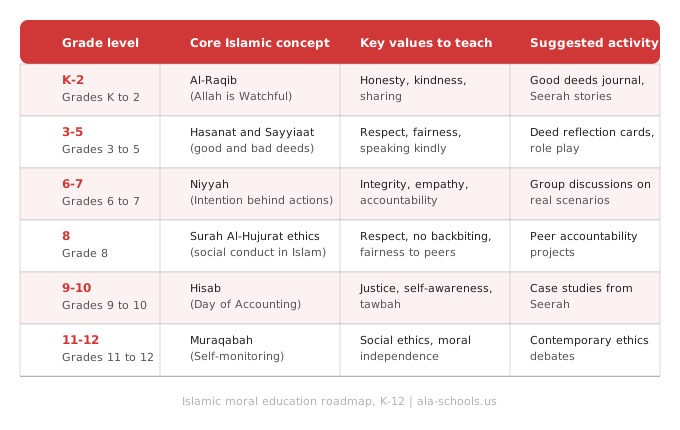
Elementary school (Grades K-5): planting the seeds
At this age, children are concrete thinkers. They learn through stories, repetition, and watching the adults around them. Abstract theology does not land yet. What does land: relatable examples, short stories, clear cause and effect, and the feeling that Allah is near.
Start with the Names of Allah that connect directly to moral awareness. Al-Adl, the Just. Al-Raqib, the Watchful. Al-Wadud, the Loving. When a 7-year-old internalizes that Allah sees everything, not as a threat but as a comfort, the concept of accountability becomes personal in a healthy way. They are not hiding their actions from a distant authority. They are in a relationship with someone who is always there.
The Seerah is perfect for this age group. The Prophet before prophethood was known as Al-Amin, the Trustworthy. That story alone carries an entire lesson about why honesty matters and what it earns you over time. His kindness to animals, his patience with the man who threw trash on him every day, his loyalty to Khadijah: these are concrete, memorable, and morally rich.
Keep the concept of hasanat and sayyiaat (good deeds and bad deeds) simple and positive. A good deeds journal works well: each day, the student writes or draws one kind thing they did. The goal is not earning points. The goal is helping children notice their own actions and feel good about choosing well.
Values to focus on at this stage: honesty, respecting parents and teachers, sharing, speaking kindly, and looking out for others. These are the building blocks. Everything else builds on them.
Middle school (Grades 6-8): building moral reasoning
This is where things get more interesting, and more challenging. Aql starts functioning in a more sophisticated way during early adolescence. Students can begin reasoning about right and wrong, weighing competing values, and questioning things they were taught as younger children. That questioning is not a problem. It is a sign that their moral development is proceeding normally.
The concept of niyyah (intention) hits differently at this age than it did at 7. A 12-year-old can genuinely grapple with the idea that the same action can be worship or meaningless depending on what is behind it. Cheating on a test when the teacher is watching versus when they are not: why does it feel the same to Allah even when it feels different to us?
Surah Al-Hujurat is worth studying as a full unit at this level. It covers backbiting, mockery, making assumptions about others, and how Muslims are supposed to treat each other. Every single one of those topics is live in a middle schooler’s social world. Teaching that content in direct connection to what they are already navigating makes it relevant instead of abstract.
This is also a good age to introduce Hisab more directly. The weighing of deeds, the concept of the Book of Records, the reality that nothing is lost or forgotten. Not to frighten, but to help students understand that the small ethical choices they make every day are building something. For better or worse.
Group work framed around Islamic cooperation, ta’awun, also teaches accountability experientially. When students understand that their contribution to a group reflects on their character before Allah, not just in front of their teacher, it changes the way they show up. The goal of Islamic moral education at this level is to help students own their values, not just repeat them.
High school (Grades 9-12): owning their faith
Teenagers who were taught “because Islam says so” without reasons often disconnect when they leave the structure of school or family. High school is where students need to move from inherited values to internalized ones.
This means teaching ethics through the lens of hikmah, the wisdom behind Islamic rulings. Why does Islam prohibit certain things? What harm do they cause, to the individual, to families, to communities? Students who understand the reasoning are far more likely to hold those values when nobody is checking.
Muraqabah, self-monitoring, is the concept to anchor high school moral education around. A student who corrects their own behavior because they know Allah sees them has internalized accountability in a way that no external system can produce. That is the goal. Not compliance. Character.
Social ethics deserve serious attention at this level too. Islamic accountability is not just personal piety. It covers justice, fairness in dealings (Surah Al-Mutaffifin is worth reading in this context), treatment of non-Muslims, environmental responsibility, and the obligation to speak truthfully even when it costs something.
Contemporary case studies work well here: what does Islamic akhlaq say about social media behavior? About income and spending? About relationships? Students who can apply Islamic ethics to real scenarios they are actually facing are genuinely learning. Students who can only recite rulings in a classroom are not.
What actually works in online Islamic education
Teaching Islamic morals and accountability in an online setting comes with a real and interesting advantage that most educators underuse.
In a virtual classroom, the teacher cannot see everything the student is doing. That limitation is a teaching tool. This is what your relationship with Allah looks like. He sees what your teacher cannot. A student who behaves well because a camera is watching has not internalized anything. A student who behaves well because of Muraqabah has.
Parents are the multiplier in online learning. The school can introduce the concepts, but the home is where they get reinforced. That means parents need practical roles: a short reflection after Quran class, a dinner table conversation about something from that week’s Islamic studies lesson, modeling the akhlaq they want to see in their children. The school and the home have to be telling the same story.
One of the most effective things about a full-time Islamic school model is that moral education does not have to live in one class period. Math teaches fairness. History shows what happened to communities that chose injustice. Science is a vehicle for tafakkur, contemplation of Allah’s signs. When Islamic values run through every subject, children do not experience them as a separate religious layer. They experience them as the way things work.
This is the approach built into ALA’s K-12 academics program, where Islamic character development runs alongside academic learning rather than being treated as a separate add-on.
Mistakes parents and educators make when teaching Islamic ethics
A few honest observations, because this stuff matters.
Using fear as the only motivator is one of the most common. There is a place for teaching children about consequences, including serious ones. But a child who only avoids bad deeds because they are afraid of punishment has not developed a conscience. They have developed avoidance behavior. When the fear is removed, so is the behavior. Pair every lesson about consequences with a lesson about mercy, tawbah, and Allah’s love.
Teaching rules without reasons is the second. “You cannot do that because it is haram” is not moral education. It is a rule. Children who understand why something is prohibited, what it does to the heart, to relationships, to the community, are far more likely to avoid it out of genuine conviction.
Inconsistency between what is taught and what is modeled is the one that probably does the most damage. Children are very good at noticing the gap between what adults say and what adults do. If Islamic ethics are talked about at school but ignored at home, the child learns that they are performance, not reality.
Treating Islamic studies as completely separate from everything else is also a problem. If Islamic values only come up during “Islamic class,” students learn to compartmentalize. The goal is for Akhlaq to be on the air, not one period on the schedule.
And finally: not adjusting for the developmental stage. A 6-year-old and a 15-year-old are in genuinely different places morally and cognitively. Talking to both of them the same way produces the same result as it would with any other subject: confusion for the younger child and condescension for the older one.
What good Islamic moral education actually looks like
Here is the honest answer: it looks less like a class and more like a culture.
A student who corrects their own behavior before being caught, because they have internalized Muraqabah. A student who genuinely wants to do good deeds, not for the praise but because they love Allah and want to meet Him well. A student who can explain why they hold their values, not just that they do. A family where Islamic ethics come up naturally at dinner, not only in formal lessons.
That does not happen by accident. It takes a school environment that takes character formation seriously, parents who stay engaged, and a curriculum that treats Islamic values as the foundation rather than an afterthought.
The families who enroll at ALA Schools are, by and large, looking for exactly this. They want their children to graduate with a real US diploma and a real Islamic character. Both of those things require sustained, intentional effort over many years.
If you are exploring what that looks like in practice, the admissions page is a good place to start. The 2026-2027 enrollment is currently open, and the team is available to walk you through how ALA’s program approaches both academic and character education across every grade level.
Final thought
Islamic moral education is not a course. It is not a checklist. It is not something that happens in one place and nowhere else.
It is a long, sometimes frustrating, always worthwhile process of helping a child build a conscience rooted in their relationship with Allah. Schools play a part. Parents play a bigger one. And the child, gradually, starts to take over that responsibility themselves.
No one does it perfectly. What matters is that it is taken seriously, consistently, and with the right understanding of what you are actually trying to build.
American Leadership Academy (ALA Schools) is a Cognia-accredited full-time Islamic school serving students in Texas, Oklahoma, North Carolina, and online. Enrollments for the 2026-2027 school year are open now.
Tags: good deeds and bad deeds in Islam, Islamic ethics for children, Islamic homeschool curriculum, Islamic moral education, Islamic values for kids, K-12 Islamic studies, Muslim student character development, online Islamic school, teaching accountability in Islam